
| Meetings | Club Pictures | Directions | Bowl Show | Newsletter |
| FORUM | Exchange Bulletins | Local Shops | Membership | BOD |
| Links | Breeders Award | Sponsors | TBAS By-Laws | Home |
| Osmoregulation, Ionic Imbalance & pH by Joe Gargas |
| Wow! And what a long time its been, most of you that remember me know that besides being a Discus Breeder since the 70s, I also was the director of Research and Development for the Wardley Corporation. Soon thereafter the Hartz Mountain company bought out Wardley and I was transferred along with my whole family to this great state of Florida in the Tampa area in 1995. I left the company in 1997 as they were preparing to sell off the “Pet Specialties Division”. Subsequently, I also left the Tropical Fish Industry for 12 years. During that time I got involved in the Potable Water Industry along with the Swimming Pool Industry and learned much more about water chemistry and treatment. I tested, studied and researched other alternatives for drinking water and swimming pool disinfection utilizing ozonation and the electrolysis process. Through this effort I was granted 5 patents for the new technologies/ applications I developed. Which are being used today in swimming pools and drinking water in the State of Florida. I recently decided to get back into the Tropical Fish hobby by giving my first presentation in 12 years to the Tampa Bay Aquarium Society which I now consider my home base last October 2009. I had and agreement with Hartz Mountain that I would no longer breed fish when I came down to the Tampa area. However, my interest peaked when I had a meeting schedule with the current Wardley Product line management under the Hartz Mountain banner at the Global Pet Expo in Orlando Florida last March 2009. The Hartz Mountain pet specialties division that owns the Wardley name was sold twice since I left. My biggest surprise was that all the companies that I once new as Tetra, Marineland, Instant Ocean, All Glass Aquarium, Perfecto Aquarium, Jungle, Aquarium Pharmaceuticals just to name a few are now owned by the 3 major players in the pet industry – United Pet Group, Royal Pet, and Central Garden & Pet. It seems that everyone wanted to be a GM! THE WHOLESALERS HAVE BECOME THE MANUFACTURER. To me this was shocking! To remind the readers I have been out of the tropical fish/pet industry for 12 years coming back and seeing this was incredible. I looked at many of the products for sale and I could not believe the amount of products that were being sold for aquarium use as water conditioners/additives for tropical fish that would do absolutely nothing and may even be counter productive in keeping and maintaining tropical fish. For those older hobbyist, remember in the 60s and 70s therewere only a few products that you could count on one hand that were used for aquarium fish as additives and there were really no problems; fish grew and reproduced along with plants, look at what the hobbyist is “bombarded’ with now just about everything under the sun. It appears the days of Research and Development in the Tropical Fish Industry have come to an end. If someone comes up with an idea for a product it is determined not if the product works but “is it marketable”. Tropical fish have always been my passion and I’ve truly missed being involved in breeding as well as developing new products for the hobby. I’ve decided to get back into the breeding of low conductivity soft water species of fish which I was doing for all of those who remember me back in the Chicago area before I got transferred. This being the first article I have written in over 12 years I will attempt to give answers to problems that many aquarist have when adding additives, or when distributors add additives before they ship their fish, especially salt and other so called “conditioners” that have a high chloride and sodium content. First, I would like to begin with Total Dissolved Solids (TDS) which is the most important water quality parameter(not pH)in keeping tropical fish. By the way I am sorry for the math involved here but there really is no other way to get the subject across to you. TDS First of all we must understand TDS Total Dissolved Solids – This is a gravimetric test which means it is a measurement of weight. If it is done by a meter it is actually conductivity not TDS. From what I can remember cities like the Chicago, Illinois would do this once a year. They would use specific size ml. beakers, a group of them; weigh each one to get the tare weight (empty weight). The first round would be a non filterable water sample – raw water from the plant that was taken from a few miles off shore would be put in each of the beakers. The beakers would be heated slowly to get the water to evaporate they would then be cooled. Each beaker would then be weighed and the result would be multiplied by a known factor (I think it was a 1000). This would be non-filterable TDS the total would be averaged together to get a TDS amount in mg/l or ppm. They would do this again but filter the raw water sample through a micron filter – the result would be filterable TDS so usually on a water report you will have 2 TDS measurements – filterable and non filterable TDS. Conductivity After the TDS results were known a conductivity test was performed and a value was then determine to multiply against the conductivity to get as close as possible to the known TDS. If a value is not known the default value has always been around .64. The city of Chicago’s value at one time was .53 Hillsborough County, where Tampa is located, is .63. All cities will have a conversion factor from conductivity to TDS. In the mean time if you do not have one a conversion factor the default of .64. Conductivity meters will always have 2 metal probes to measure the circuit the amount of electric current that they give off in the water. What are called cations have a positive charge +. And what is called anions have a negative charge - . Both charges are needed to complete a circuit. Examples of cations having a positive charge (+) are Sodium, Potassium, Calcium and Magnesium (there are many others) the anions have a negative charge (–) use MicroSiemens the symbol for MicroSiemens is a small u and a large S (pS). The Symbol for MilliSiemens is a small m and large S (mS). MilliSiemens are used if the conductivity is above 2000 MicroSiemens. Swimming pools and saltwater aquaria will need a meter that read in mS (MilliSiemens). Saltwater swimming pools that use a cell require conductivity in the range of 6-8 MilliSiemens. FYI 1 MilliSiemens = 1000 MicroSiemens (6 MilliSiemens = 6000 MicroSiemens) Ok so we know a bit about TDS and Conductivity. What does that mean to the Aquarist? Zoos and public aquariums will all agree that when you keep captive animals you need to have an environment as close as possible to the natural environment that the species come from. With tropical fish it is no different. Rainforest species must have a water quality of a rain forest. Lake Species from the Rift Lakes in Africa have a water quality much different than rain forest species. Ok we need to get from conductivity to TDS to Osmotic pressure. Osmotic pressure is the hydrostatic pressure produced by a difference in concentration between solutions on the two sides of a surface such as a semi-permeable membrane or cell (Ed: or for instance the cell on the gill of a freshwater fish and the surrounding water). Osmotic pressure also occurs in and around freshwater fish as they must keep on osmoregulating . . . spending much energy retaining salts and excreting water. Ok . . . we tested the tap water(Ed: Sarasota, Fl) that we filled a 10 gallon tank with. The conductivity was 670uS (MicroSiemens): 670 x(multiply) by .64 (We do not have a conversion from Sarasota Water Dept.) 670 X .64 = gives us an approximate TDS value of 428.80 mg/l or ppm. Now we take the TDS and divide it by 100 to get the Osmotic Pressure: 428.80 ÷ 100 = 4.28 lbs per square inch Osmotic Pressure. Some fish species can tolerate higher Conductivity, TDS and Osmotic Pressures than others in comparison to their natural habitat. What makes matters worse, though, is when aquarium salt and other additives are added to the aquarium . . . not only does the conductivity increase but now the ions that were in balance in the natural water(tap water or water source) are completely out of balance. To explain this better ionic imbalance occurs when Chloride and or Sodium become the major cations or anions in water. Then it becomes imbalanced and unnatural. If you look at just about all fresh waters with very few exceptions it is calcium and or magnesium that are the major cations and sulfate, alkalinity/bicarbonate/ carbonate are the major anoins. Even in Lake Tanganyika which is the biggest exception to the freshwater rule the principle cation is magnesium and the major anion is bicarbonate/ carbonate. These ions even though they are water soluble they are much less soluble than the chloride and sodium ions. All aquarium additives have one thing in common, included in their products are chloride and sodium. It is the chloride ion then the sodium ion that are taken in by the freshwater fish due to there water solubility. When these ions are so numerous and are the chief cations and anions in an aquarium, the freshwater fish is under much stress osmoregulating thus spending much energy as chloride and sodium are being taken up. Freshwater fish are hyperosmotic which means that they have to maintain a higher concentration of salts in their body then the surrounding water. Then, if that fish is moved to waters with lower chloride and lower sodium and naturally a lower conductivity then it is stressed further as water naturally moves to the higher ionic concentration (4). When I was with Wardley/Hartz we analyzed competitor’s products as we were looking for a product to compete with other conditioners. We tested them by analyzing blood work on fish after using specific products we saw that after 72 hours the Cortisol (Cortisol is an indicator of stress it is found in the blood it is released as a response to stress) levels started to increase rapidly. One of the most characteristic aspects of stress in fish is osmoregulatory disturbance, which is related to the effects of both catecholamine and cortisol hormones. The extent of the disturbance following stress depends upon the ionic and osmotic gradients (difference) between the internal fluids of the fish and its surrounding environment (water). If the stress is persistent and of sufficient intensity, changes in the cellular structure of the gills may occur under the influence of cortisol. In this situation, increased death and turnover rates of branchial epithelial cells leads to accelerated aging of the gills. These degenerating and newly-formed gill cells do not function normally, which further limits the fish’s ability to maintain water and ion homeostasis under stressful conditions. Thus, acute stress limits the fish’s capacity to osmoregulate, and prolonged periods of extreme stress may result in osmotic shock and death. This is especially true if the chloride and sodium ions are present in such abundance that they become the major anions and cations in the water superseding calcium, magnesium as the cations and alkalinity/carbonate/bicarbonate and sulfates as the anions Even though the conductivity will always increase in an enclosed environment it is the chloride ion then the sodium ion that are usually the culprits. That is especially true if the chloride anion along with the sodium cation increase to the point that they are now the most abundant of both the cations and anions. I would get calls when stores where having problems with aquarium fish stock. The first thing the stores would do would be to blame it on the supplier without looking at their own aquarium set up. There was an issue with a Wal-Mart store in Fayetteville, Arkansas back in 1996. They had major die offs with a week after receiving the shipment – I requested 2 samples of their water. The first sample was to have been from the tap water and the second from the aquariums (they were on a central system). Below is the analysis: Tap Water Wal-Mart, Fayetteville Arkansas Conductivity: 174 μS (MicroSiemens) (GREAT WATER FROM THE TAP!) TDS: (174) x (.64) = 111.36 mg/l or ppm Osmotic Pressure: (111.36)/(100) = 1.11 lbs per square inch Total Hardness 80 mg/l ppm Calcium 70 ppm (as CAC03 Calcium Carbonate) x .4 to get calcium ion = 28 ppm Magnesium 10 ppm (as CAC03 Calcium Carbonate) x .24 to get magnesium ion = 2.4 ppm Alkalinity 60 ppm (as CAC03 Calcium Carbonate) x .61 to get Bicarbonate ion = 36.6 ppm Chloride 16 ppm as Chloride = 16 ppm Sulfate 10 ppm as Sulfate = 10 ppm Sodium Na+ can only be measure with major equipment such as an atomic adsorption or a Mass Spect. however, we can get an educated guess by multiplying the chloride ion Cl- x .65 to get an guesstimate of the Sodium so in this case the amount of Sodium would be. Chloride: 16 x .65 = Sodium, therefore Sodium = 10.40 ppm 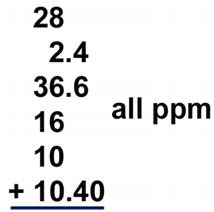 103.40 ppm >We just dissected the tap water . . . now add up all the results that are underlined and see how close we get to the TDS . The Total comes to 103.40 ppm. The approximate TDS is 111.36 ppm After adding the ions we got 103.40 Subtracting those two values 111.36 - 103.40 ________ 7.96 ppm The difference is 7.96 ppm or mg/l of substances that are not accounted for from the TAP WATER . . . THIS IS GREAT! The water is very well balanced iononicly and the remaining difference 7.96 ppm can be attributed to the Sodium as it may be all extra Sodium. Now lets look at the aquarium tank water from the Wal-Mart in Fayetteville, Arkansas and Compare this to the tap water starting point. Tank Water Wal-Mart Fayetteville Arkansas Conductivity: 1760 μS x .64 = 1126.40 mgl/ ppm (TDS) TDS: (1760) x (.64) = 1125.40 mg/l or ppm Osmotic pressure: lbs per square inch Total Hardness 100 mg/l ppm Calcium 80 ppm (as CAC03 Calcium Carbonate) x .4 to get calcium ion = 32 ppm Magnesium 20 ppm (as CAC03 Calcium Carbonate) x .24 to get magnesium ion = 4.8 ppm Alkalinity 40 ppm (as CAC03 Calcium Carbonate) x .61 to get Bicarbonate ion = 24.40 ppm Chloride 424 ppm as Chloride = 424 ppm Sulfate 4 ppm as Sulfate = 10 ppm Nitrate No3 10 ppm = 10 ppm Sodium Na+ can only be measure with major equipment such as atomic adsorption or Mass Spectrometer however we can get an educated guess by multiplying the chloride ion Cl- X .65 to get an guesstimate of the Sodium so in this case the amount of Sodium would be: Chloride: 424 x .65 = Sodium , therefore Sodium = 275.60 ppm 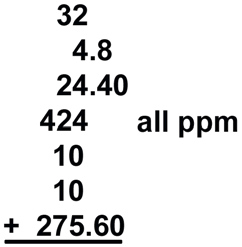
780.0 ppm We just dissected the aquarium water now add up all the results that are underlined and see how close we get to the TDS . The Total comes to 780.80 ppm The approximate TDS is 1126.40 After adding the ions we got 780.80 subtracting these two numbers like above: Unknown Difference 345.60 Now the difference maybe other minerals besides Sodium that have been added to the water by someone!! Not only have there been additives added to this water but there is no longer an ionic balance which is just as important in the osmoregulation of fish besides the Osmotic Pressure. After looking at this data it becomes a very strong argument against adding additives and salt . . . Sodium Chloride . . . to fresh water aquariums. I do know that this Wal-Mart store did use a lot of Stress Coat and salt. There may have been other additives which I was unaware off but not only did it increase the Conductivity, TDS and Osmotic Pressure it also produced an un-natural water by an improper balance of ions (Ionic Balance). As you can see the Chloride ion is now the major anion superseding, alkalinity/carbonate bicarbonate, sulfate and sodium is now the major cation superseding calcium and magnesium, This is still a continual problem in some retail stores today, and is something that must be avoided at all costs. Some stores and distributors add tremendous amounts of salt to there aquariums. Petco in Brandon Florida actually has a plastic container in each aquarium full of salt with a lid on that has been punched full of holes. The salt dissolves and the conductivity builds up the fish look terrible. People that I know that have purchased fish from that store have lost them within a week there maybe exceptions to that rule with very strong and hardy species that where in very good condition to begin with but why play with fire. I have checked the conductivity of the aquariums of other stores such as PetsMart along with other stores and found that the conductivity was as high as 4000 to 6000 MicroSiemens due to the addition of salt and other additives making the total dissolved solids 3840 ppm and the osmotic pressure over 38 lbs per square inch. What natural freshwater environment compares to that!? One hobbyist I know who is an advanced aquarist looses at least 40% of everything he gets from a distributor/importer that uses as part of the companies protocol ½ to ¾ of a full cup of salt per 10 gallons of water. This would be ok if it were used as a quick bath or dip against parasites but it is completely wrong to keep fish in an environment such as this for any given length of time. Now for another example: let’s look at another product KENT Marine Discus Essential. Being a discus enthusiast and a commercial breeder in the past of this marvolus fish, I have spent much time researching to obtain the best water quality I could produce for this fish. The Amazonian region is very low in minerals and has no metals and the conductivity is very low along with the hardness. I looked at the MSDSA sheet on this product (Material Safety Data Sheet): This product contains: CALCIUM CHLORIDE & STRONTIUM CHLORIDE . . . and it also contains less than 50 ppm each of zinc, copper, lithium, nickel, cobalt, iron, magnesium, manganese, molybdenum, potassium, and selenium as minor trace minerals. Once again heavy on the chloride and just look at those heavy metals why would anyone want to use this product with Discus? I sure would not! So what is the solution? The BEST water conditioner and treatment method that I have used for over 30 years is activated carbon – not in the aquarium but for the water to run through and activated carbon tank or cartridge system on its way to the aquarium. By using this process all the chlorine will be removed in one pass and if you have chloramines as we do down here in Florida the Chlorine/Ammonia bond will be broken and only a small amount of ammonia will be left that will be assimilated by the nitrification cycle. Many hobbyist hobbyists have used this process for many years with great success. So what are the actual benefits? By using an activated carbon process to condition the water no salts or other substances are being added to the aquarium. The cost is also much less depending on your chlorine concentration a carbon cartridge can last a few thousand gallons vs. paying for a liquid conditioner that may cost over $50.00 a gallon and increase the conductivity in the aquarium. A pet store can really benefit by this type of application by utilizing a large carbon tank and no longer have to worry about chemicals. I am currently working on a cartridge that contains another item besides carbon it will treat between 8-to 12,000 gallons and works by an Electrochemical/ Oxidation Reduction Process removing metals, chlorine, hydrogen sulfide, and killing any bacteria in one pass. It does this by taking up or giving up electrons, the results so far have been good. This would not be something you would add to your aquarium filtration system but would soly be used in filling the aquarium with tap water . . . or your water changing process. pH Last but not least I would like to touch on pH. First of all pH means only one thing. The power of Hydrogen. It is the negative logarithm (Ed: meaning a very steep curve . . . numbers happen quickly) of the hydrogen concentration. Thus it is the measurement of the hydrogen ions in water they are non-toxic to fish in there own right. Fish that come from a low pH also come from soft waters with low hardness low TDS and low conductivity. Lake Tanganyika which has a conductivity between 606 and 700 MicroSiemens is hard with low concentrations of Calcium and high concentrations of Magnesium (see 1,2,3) and has a very high pH, higher than seawater, and is strongly buffered with an alkalinity exceeding 300 mg/l as CaC03 A fish species, from the Amazon or any rainforest, as long as the conductivity is low, then the hardness will be low and the pH will be low however, for aquarium purposes it does not matter if the pH is 6.8 or 7.8. A misinformed fact regarding pH is the term “pH shock” There is no such thing!! Many Florida fish farmers can attest that they see pH changes through out the day especially in a pond that has many plants. In the morning the water can be as low as 5 and at mid day it can go up to 7.5 this is NATURAL. Let me share a recent experience. I have a 150 gallon aquarium that is an Amazon tributary type set up with plants. I have Apistos. Cardinal Tetras, Checker Board Cichlids, Rummy Nose Tetras these are some of the species I keep. I recently noticed my plants were not growing they appeared to be dormant and I had a problem with black beard algae. I had no problem with the fish. I check my nitrates and I had none. I then check my pH which I really never do and found out it was 4.4. I employed a small 12" fluidize bed filter off the side stream of my main pump and filled it with 2 handfuls of aragonite which is a refined form of calcium carbonate and is sold for reptiles and arachnids as a substrate. The fluidize bed had just enough water current to cause the sand just to tumble not even fluidize. The result overnight was the pH increased from 4.4 to 7.2 within 8 hours the fish did not show any signs of stress at all and one of my apistos even spawned. After 2 weeks the black beard algae began to disappear the pH is now at 7.4 and I turn the fluidize bed/carbonate buffering system off during the day and on at night. I may note using this method only increased the conductivity by 20 MicroSiemens. With this in mind I have a few recommendations about pH. The biggest issue with pH is that in an aquarium the pH will always become acidic the more efficient your filter is in Nitrifying – biologically oxidizing the ammonia to nitrate the more hydrogen ions H+ will be produced eventually reducing the buffering capacity (alkalinity) then causing the pH to fall. A few rules of thumb never ever add an acid to lower the pH in an aquarium as it is not needed regardless what the hobbyist magazines say. Remember the aquarium trade magazines such as TFH, FAMA, Aquarium Fish are not by no means scientific journals they are referred to as periodicals in the scientific arena. The only scientific aquarium magazine that was ever available to the hobbyist was Discus Brief which was from Germany and was distributed in the USA. If you submit an article to a scientific magazine or journal it has to be reviewed by a number of other scientist or piers and if it passes the intense scrutiny it will be published. The other rule of thumb no matter what type of aquarium you have a buffer system should be employed as it will prevent your alkalinity from disappearing and pH from falling allowing your nitrification (biological filtration) to continually function. Nitrification slows down at a pH of 6.5 and will stop below 6.0. For African Cichlids especially species from L. Tanganyika I would use a substrate of dolomite gravel or dolomite sand. Dolomite is calcium and magnesium carbonate it has equal parts of calcium and magnesium it will not injure the mouth of the fish as crushed coral may and since it is light in color it really brings out the color of fish. You can also have a fluidized bed of dolomite this will buffer the pH nicely without raising the conductivity that much or you can also put a bag or dolomite or aragonite in a filter bag suspended in a power filter or in the aquarium but the results will not be as good as having it tumble in a fluidize Bed. Aquarist that are really serious about Lake Tanganyika Species, require almost a separate protocol as it is different from most other freshwater species and lakes and is more similar to a marine environment fist of all the waters are hard the calcium and magnesium ratios are much different as now magnesium exceeds calcium. The calcium is 44 ppm as CaC03 and the magnesium is as high as 180 ppm measured as calcium carbonate thus having a total hardness of 224 as CaC03 and a conductivity measure as high as 700 MicroSiemens. Comparing this to Lake Malawi with a conductivity of 220 MicroSiemens and a total hardness of only 85.60 ppm (with the calcium at 49 ppm as CaC03 and the magnesium as 36.6 as CaC03) thus showing Lake Malawi is not as hard as one may think but is rather soft. (any type of Malawi Cichlid Salts are a mute point (see references 1,2,3, below). However, Lake Tanganyika is so different not only in its magnesium to calcium ratio but the alkalinity and pH, is higher than seawater being around and possibly over 300 ppm as CaC03 and having a pH up to 9.06. Since this water is so different and its species are so specialized it would be strongly advised that the aquarist invest in a couple of water test kits. I recommend the following kits from LaMotte: 1) Hardness Kit Model PHT-CM-DR-LT CODE 4824-DR-LT. This is a titration kit and it reads in ppm and is very accurate. You will be able to determine Total Hardness, Calcium Hardness and Magnesium Hardness. 2) Alkalinity Test Kit model WAT-DR CODE 4491-DR. This is another titration lit and it reads in ppm and is very accurate. 3) Any High Range pH kit. 4) A conductivity meter which all serious aquarists should have. Here is the link to find one: http://www.coleparmer.com/catalog/product_view.asp?sku=3546230 This is what is called WU-35462-30 Eco Testr EC Low Only $60. I would add to the Lake Tanganyika Aquarium definitely some sort of buffering system described above. Along with that I would then add enough magnesium in the form of magnesium sulfate (Epsom salts) to obtain around 100 ppm as Magnesium Carbonate CaC03 say a tablespoon per 10 gallons at a time to start. Then you would have to test for hardness by titrating and see what the levels have climbed to if you had a scale it would be better then you can weigh exact amounts. To raise your alkalinity and this is something I would only do for these species. Would be to add “Potassium Carbonate” , “Sodium Hydrogen Carbonate” or “Magnesium Carbonate” the same way you added the Epsom salts but instead of performing a hardness test you would test your alkalinity after each addition. (Magnesium Carbonate would be great to add to a fluidized bed). Before you do this make sure your pH is already above 7 and that you have no ammonia present . If your water is already basic and you have no ammonia present – you will not have a problem increasing your pH rapidly! The Tropical Fish industry and aquarium hobby is going through a big transition nobody knows what is going to happen due to the economy and having most all the products owned by three major companies. In fact one of those companies just recently filed a type of chapter 11. The keeping of tropical fish has been the 3rd most popular hobby next to photography which is number #1 and stamp collecting #2. Our hobby being very unique in that it was then end user, not the manufacture/distributor, that becomes the authority/expert on the species we keep and how they are best kept. We have been slammed with so much marketing, misinformation and confusion that we now lost that edge. Its time to find out when we are successful breeding and keeping species of fish we need to know why are we successful so we can have a point of reference to go back to. Remember what we add to our aquariums stays and builds up over time even if you do water changes unless you do a 100% change! Water analysis also need to be performed and data needs to be collected and maintained, after we start collecting this information and have a point of reference we just may become the experts once again getting our edge back from the mass marketing system. Then we can tell them what works for us instead of being told what we need! References Cited 1. Lake Tanganyika Fisheries Research (Physicaland limnological aspects) Lindqvist O.V., Mölsä H., Salonen K. & J. Sarvala (eds.), 1999, From Limnology to Fisheries: Lake Tanganyika and Other Large Lakes, Developments in Hydrobiology 141, ISBN 0-7923-6017-6, Kluwer Academic Publishers, Dordrecht, The Netherlands: 218 p. (sold and distributed in North, Central and South America by Kluwer Academic Publishers, 101 Philip Drive, Norwell, MA 02061, USA) 2. What is the chemical composition with Lake Malawi Water? How Does it compare to Lake Victoria and Lake Tanganyika Last Update: 18 April 2009 Web Author: M. K. Oliver, Ph.D. Copyright © 1997-2009 by M. K. Oliver - ALL RIGHTS RESERVED 3. FLUORIDE: GEOCHEMICAL AND ECOLOGICAL SIGNIFICANCE IN EAST African waters and sediments. Peter Kilham2 and Robert E. Hecky3 Volume 18 issue 6 page 934 Department of Zoology, Duke University, Durham, N. C. 27706 4. Gordons page on ionic balance and osmoregulation. www.earthlife.net/fish/oregulate.html |
| . . . the Future of the Aquarium Hobby |