


Page 8 - TBAS-Aug-2020
P. 8
-8-                                                       TBAS August 2020 ....................
               As a result of these (and other) previous studies, we know that environmental
        conditions can influence how dietary energy is partitioned.
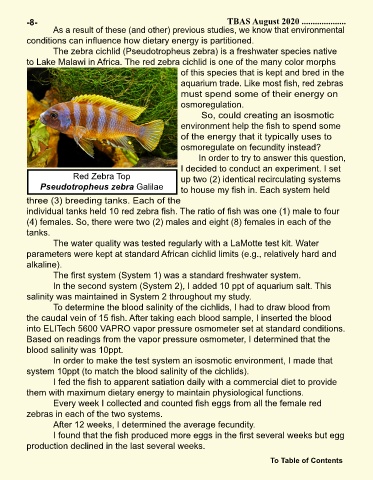
               The zebra cichlid (Pseudotropheus zebra) is a freshwater species native
        to Lake Malawi in Africa. The red zebra cichlid is one of the many color morphs
                                                  of this species that is kept and bred in the
                                                  aquarium trade. Like most fish, red zebras
                                                  must spend some of their energy on
                                                  osmoregulation.
                                                          So, could creating an isosmotic
                                                  environment help the fish to spend some
                                                  of the energy that it typically uses to
                                                  osmoregulate on fecundity instead?
                                                         In order to try to answer this question,
                                                  I decided to conduct an experiment. I set
                     Red Zebra Top                up two (2) identical recirculating systems
            Pseudotropheus zebra Galilae          to house my fish in. Each system held

        three (3) breeding tanks. Each of the
        individual tanks held 10 red zebra fish. The ratio of fish was one (1) male to four
        (4) females. So, there were two (2) males and eight (8) females in each of the
        tanks.
               The water quality was tested regularly with a LaMotte test kit. Water
        parameters were kept at standard African cichlid limits (e.g., relatively hard and
        alkaline).
               The first system (System 1) was a standard freshwater system.
               In the second system (System 2), I added 10 ppt of aquarium salt. This
        salinity was maintained in System 2 throughout my study.
               To determine the blood salinity of the cichlids, I had to draw blood from
        the caudal vein of 15 fish. After taking each blood sample, I inserted the blood
        into ELITech 5600 VAPRO vapor pressure osmometer set at standard conditions.
        Based on readings from the vapor pressure osmometer, I determined that the
        blood salinity was 10ppt.
               In order to make the test system an isosmotic environment, I made that
        system 10ppt (to match the blood salinity of the cichlids).
               I fed the fish to apparent satiation daily with a commercial diet to provide
        them with maximum dietary energy to maintain physiological functions.
               Every week I collected and counted fish eggs from all the female red
        zebras in each of the two systems.
               After 12 weeks, I determined the average fecundity.
               I found that the fish produced more eggs in the first several weeks but egg
        production declined in the last several weeks.

                                                                          To Table of Contents

