


Page 7 - TBAS-Aug-2020
P. 7
TBAS August 2020 ....................                                           -7-
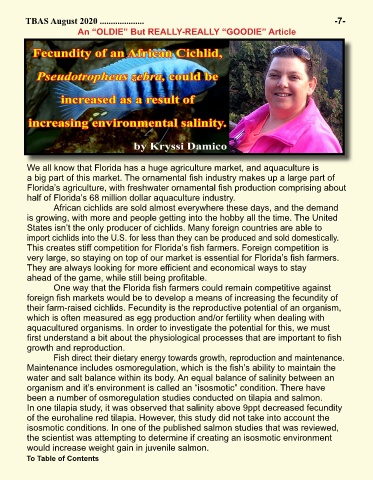
                      An “OLDIE” But REALLY-REALLY “GOODIE” Article


        We all know that Florida has a huge agriculture market, and aquaculture is
        a big part of this market. The ornamental fish industry makes up a large part of
        Florida’s agriculture, with freshwater ornamental fish production comprising about
        half of Florida’s 68 million dollar aquaculture industry.
                African cichlids are sold almost everywhere these days, and the demand
        is growing, with more and people getting into the hobby all the time. The United
        States isn’t the only producer of cichlids. Many foreign countries are able to
        import cichlids into the U.S. for less than they can be produced and sold domestically.
        This creates stiff competition for Florida’s fish farmers. Foreign competition is
        very large, so staying on top of our market is essential for Florida’s fish farmers.
        They are always looking for more efficient and economical ways to stay
        ahead of the game, while still being profitable.
                One way that the Florida fish farmers could remain competitive against
        foreign fish markets would be to develop a means of increasing the fecundity of
        their farm-raised cichlids. Fecundity is the reproductive potential of an organism,
        which is often measured as egg production and/or fertility when dealing with
        aquacultured organisms. In order to investigate the potential for this, we must
        first understand a bit about the physiological processes that are important to fish
        growth and reproduction.
               Fish direct their dietary energy towards growth, reproduction and maintenance.
        Maintenance includes osmoregulation, which is the fish’s ability to maintain the
        water and salt balance within its body. An equal balance of salinity between an
        organism and it’s environment is called an “isosmotic” condition. There have
        been a number of osmoregulation studies conducted on tilapia and salmon.
        In one tilapia study, it was observed that salinity above 9ppt decreased fecundity
        of the eurohaline red tilapia. However, this study did not take into account the
        isosmotic conditions. In one of the published salmon studies that was reviewed,
        the scientist was attempting to determine if creating an isosmotic environment
        would increase weight gain in juvenile salmon.
        To Table of Contents

